
Birth Chart Compatibility: What Two Natal Charts Reveal About Your Relationship
 Maryna Litunets · November 2, 2026
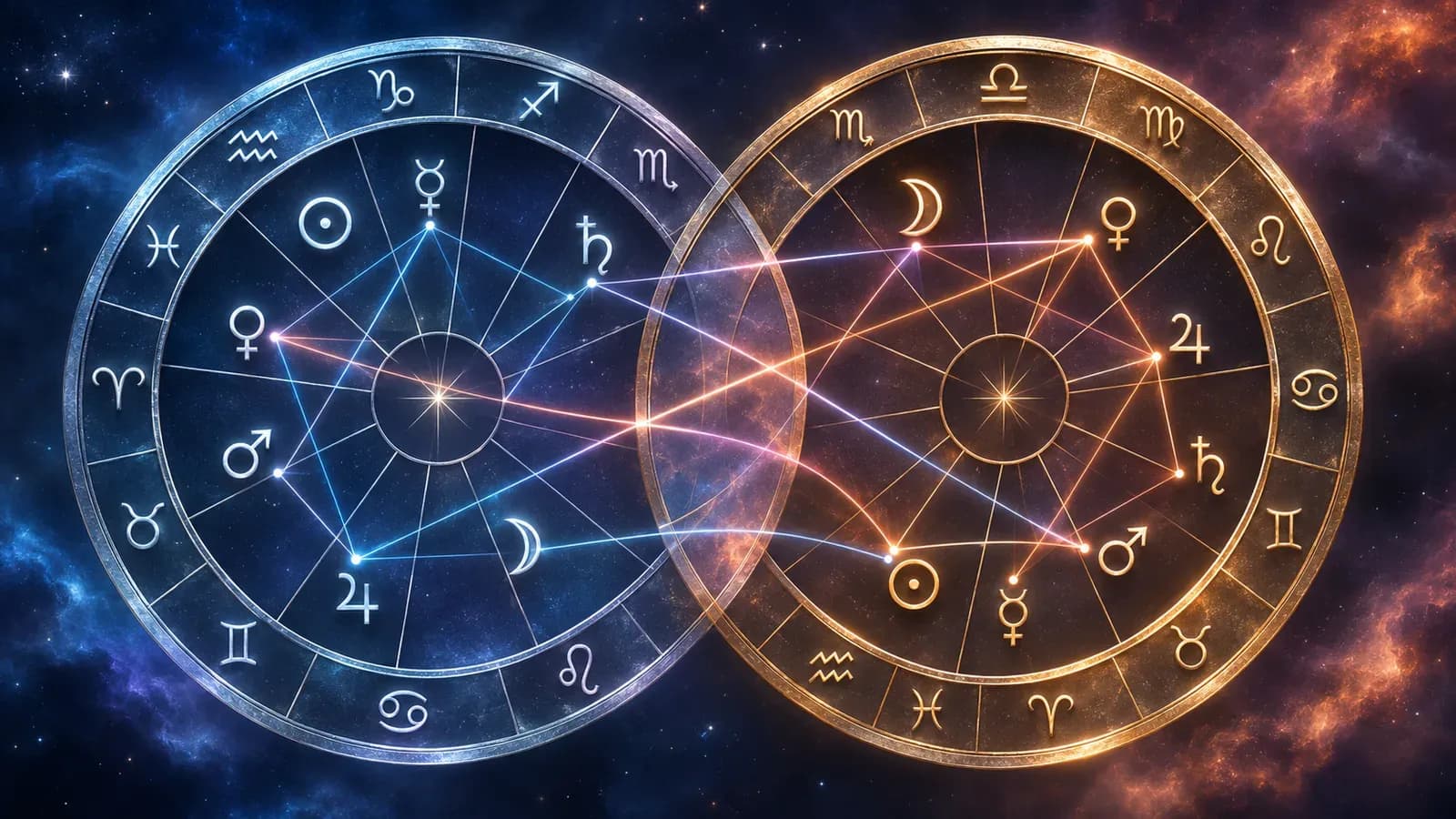
Your zodiac signs say you're a perfect match. So why do you struggle to understand each other when emotions run high? Or perhaps every horoscope warns that your signs are incompatible, yet the relationship feels unexpectedly natural. Either experience raises a fascinating question: what if Sun signs are only a small part of the story?
Birth chart compatibility examines the relationship between two complete natal charts instead of comparing two zodiac signs. Within traditional Western astrology, this approach is called synastry. It explores how the Sun, Moon, Mercury, Venus, Mars, and other planetary positions in one person's chart interact with those in another.
The difference can be substantial. Two people with contrasting Sun signs might have supportive Moon contacts, while a supposedly harmonious Sun-sign pair could have very different romantic or communication styles. Birth chart compatibility separates these symbolic themes so they can be considered individually rather than reduced to a single label.
A meaningful comparison therefore asks several questions. Where does affection seem easy? Which emotional needs may differ? What happens when one person's communication style meets the other's? And what might the chart suggest about attraction, responsibility, and long-term expectations?
This guide explains exactly how two natal charts are compared, which synastry aspects are traditionally considered important, and how to interpret a birth chart compatibility reading without treating it as a prediction of relationship success.
What Is Birth Chart Compatibility?
Birth chart compatibility is the comparison of two natal charts to identify planetary relationships and explore traditional astrological themes associated with emotional connection, attraction, communication, and partnership. Rather than relying exclusively on Sun signs, it considers where several celestial bodies were positioned at the times of two people's births.
A natal chart represents a calculated snapshot of the sky from a particular birth location and time. In Western tropical astrology, the positions of the Sun, Moon, and planets are expressed by zodiac sign and degree.
When two natal charts are compared, astrologers examine the angular distances between planets belonging to different people. These connections are called synastry aspects.
For example, one person's Moon may form a trine to the other's Venus, traditionally interpreted as an interaction between emotional comfort and affectionate expression. Alternatively, one person's Mercury might square the other's Mercury, symbolically representing differences in communication styles.
Neither aspect determines how the people will behave. The chart provides a symbolic interpretation, while real compatibility depends on mutual actions, values, communication, consent, and life circumstances.
Birth Chart Compatibility vs. Zodiac Sign Compatibility
Birth chart compatibility is more individualized than zodiac sign compatibility because it compares multiple planetary placements rather than treating everyone with the same Sun sign as equivalent. Two people born under Aries can have different Moon signs, Venus placements, Ascendants, and house configurations.
A basic zodiac comparison examines only one part of each chart. Synastry examines relationships between several parts.
Comparison method | Information used | Main focus |
|---|---|---|
Sun-sign compatibility | Two zodiac Sun signs | Identity and general symbolic temperament |
Moon-sign compatibility | Two Moon placements | Emotional habits and comfort needs |
Venus-sign compatibility | Two Venus placements | Affection, romance, and relationship values |
Birth chart compatibility | Multiple placements in two natal charts | Broader relationship themes |
House overlays | Planets from one chart placed in the other's houses | Symbolic areas of personal experience |
Composite chart | Midpoints between two charts' corresponding positions | Symbolic themes attributed to the relationship |
For a quick starting point, the AstroSynth Zodiac Compatibility Calculator compares traditional Sun-sign elements. A full synastry comparison offers much more detailed astrological information.
The Seven Chart Connections Worth Checking First
A practical birth chart compatibility reading should begin with the personal planets and the contacts most relevant to the relationship question. Not every aspect carries the same symbolic meaning, and a longer list of contacts is not automatically more informative.
The following overview identifies seven connections commonly examined in relationship astrology.
Chart connection | Traditional theme | Useful question |
|---|---|---|
Sun–Moon | Identity and emotional responsiveness | Do we understand each other's emotional and personal needs? |
Moon–Moon | Emotional comfort and daily rhythms | What makes each of us feel secure? |
Moon–Venus | Emotional needs and affection | Does our way of showing love feel supportive? |
Venus–Mars | Romantic attraction and initiative | Do we share expectations about affection and desire? |
Mercury–Mercury | Communication and thought processes | Can we explain disagreements constructively? |
Venus–Saturn | Affection and responsibility | How do we approach commitment and boundaries? |
Sun–Saturn | Identity, structure, and expectations | Can we balance personal freedom with shared responsibilities? |
These are not the only meaningful contacts in synastry. Sun–Sun, Mars–Mars, Moon–Saturn, and other interactions may also be considered, depending on the couple and the particular reading.
The purpose of prioritizing the personal planets is to keep the interpretation connected to recognizable experiences rather than creating an overwhelming list of planetary terminology.
How to Compare Two Birth Charts: A Five-Step Reading
Comparing two birth charts involves calculating both natal charts, identifying their planetary positions, examining cross-chart aspects, considering house overlays, and interpreting the relationships between those factors. The process is easier when approached in stages.
Step 1: Calculate Both Natal Charts
Birth chart compatibility begins with accurate birth information for both people. Each natal chart requires a birth date, and more complete calculations benefit from the exact local birth time and birthplace.
The date establishes the general planetary positions. The time is particularly important for the Moon and for calculating the Ascendant, Midheaven, and houses. Birthplace provides the geographic and time-zone context.
The same birthday does not necessarily produce the same natal chart. Two people born hours apart or in different locations can have different house positions and chart angles.
When the birth time is unknown, some placements can still be calculated with reasonable precision, but time-sensitive factors may remain uncertain.
Step 2: Identify the Personal Planets
The personal planets provide the foundation for most introductory birth chart compatibility readings. In traditional astrology, the Sun, Moon, Mercury, Venus, and Mars symbolize distinct personal and relationship themes.
Begin by recording the zodiac sign and exact degree of each placement.
For example, someone's Venus might be located at 12° Taurus, while another person's Mars is at 15° Virgo. These positions can be compared geometrically to determine whether a recognized aspect exists.
The exact degrees are important. Zodiac signs are useful categories, but planetary aspects depend on actual longitude.
Step 3: Calculate the Synastry Aspects
Synastry aspects are the angular connections between one person's planets and the other's, and they are central to birth chart compatibility. The most common major aspects are conjunction, sextile, square, trine, and opposition.
An aspect is considered exact when the planets are separated by its defining angle. In practice, calculators allow a tolerance known as the orb.
A trine is 120°, for example. Two planets separated by 123° form a trine with a 3° orb under a method that permits that tolerance.
AstroSynth's free Synastry Chart Calculator calculates planetary positions and cross-chart aspects. It lists the detected contacts and identifies their angular closeness.
Step 4: Examine House Overlays
House overlays describe where one person's planets fall within the other person's natal chart houses. They are a separate layer of interpretation from planetary aspects.
For example, someone's Venus may fall in another person's fifth house, which traditional astrology associates with romance, creativity, and enjoyment. Venus in the seventh house is commonly interpreted through the symbolism of partnership.
House overlays are directional. Person A's Venus in Person B's seventh house is not the same calculation as Person B's Venus in Person A's seventh house.
Because houses depend on birth time and location, uncertain birth times can make house interpretations unreliable.
Step 5: Interpret the Whole Pattern
A birth chart compatibility reading should consider how several contacts interact instead of using one aspect as a verdict. A chart may contain both traditionally harmonious and challenging connections, each associated with a different relationship theme.
A Moon–Moon trine might symbolize emotional ease, while a Mercury square could suggest contrasting communication preferences. Both can be present without cancelling each other.
The useful reading explains where the symbolic themes differ and offers questions that help a couple examine their actual experiences.
The result is more informative than classifying the relationship as simply good or bad.
Synastry Aspects Explained: Which Ones Matter Most?
The meaning of a synastry aspect depends on the planets involved, the angular relationship between them, and the wider chart context. Traditional astrology classifies some aspects as comparatively harmonious and others as more challenging, but no aspect automatically predicts a real-world outcome.
Aspect | Exact angle | Traditional interpretation | What to consider |
|---|---|---|---|
Conjunction | 0° | A strong blending or concentration of planetary themes | Similarity, intensity, and potential blind spots |
Sextile | 60° | An opportunity for cooperation | Shared effort and conscious participation |
Square | 90° | Friction between different approaches | Negotiation and recurring misunderstandings |
Trine | 120° | Relative ease and familiar rhythms | Comfort without taking understanding for granted |
Opposition | 180° | Contrast and potential complementarity | Balance, boundaries, and different expectations |
Conjunction: A Powerful Point of Contact
A conjunction occurs when two planets occupy approximately the same zodiac longitude, traditionally symbolizing a concentrated interaction between their themes. Whether that interaction feels supportive or difficult depends on the planets and the individuals involved.
A Moon–Moon conjunction may suggest familiar emotional habits. A Mars–Mars conjunction might symbolize shared initiative or a tendency toward competing approaches.
A conjunction should not automatically be classified as positive. Similarities can support closeness, but they can also intensify habits that both people find difficult to manage.
Trine: An Easier Flow Between Planets
A trine forms at approximately 120° and is traditionally interpreted as a comparatively harmonious connection. When personal planets form a trine, astrologers often describe their symbolic themes as interacting with less friction.
For example, a Moon–Venus trine may be associated with affectionate reassurance, while a Sun–Saturn trine can symbolize the interaction between personal identity and responsibility.
The presence of a trine does not establish that two people will cooperate effortlessly. It describes an astrological relationship rather than observed behavior.
Sextile: Compatibility That Develops Through Participation
A sextile forms at approximately 60° and traditionally represents an opportunity for cooperation. Unlike a trine, the sextile is often interpreted as something that benefits from active engagement rather than automatically creating ease.
Two people may approach romance differently but discover that their preferences complement each other when they plan shared activities.
The practical lesson is that supportive potential becomes meaningful only when both individuals make an effort to understand one another.
Square: The Relationship's Friction Points
A square forms at approximately 90° and traditionally symbolizes tension between planetary themes. In birth chart compatibility, squares may suggest different instincts or expectations that require negotiation.
A Mercury–Mercury square, for example, might be interpreted as contrasting styles of communication. One person may prefer direct conclusions, while another wants to explore possibilities before deciding.
The square does not mean that arguments are inevitable. It offers a symbolic reason to pay attention to a particular topic.
Opposition: Two Sides of the Same Question
An opposition forms at approximately 180° and traditionally describes contrasting approaches that may attract, challenge, or complement one another. The aspect can be especially interesting when both people recognize qualities in the other that differ from their own.
A Moon–Moon opposition may be interpreted through contrasting emotional preferences. One partner could seek familiarity while the other needs more variety or independence.
The potential value lies in understanding the contrast without turning it into a competition over whose preferences are correct.
How Exact Degrees Change a Birth Chart Compatibility Reading
Exact planetary degrees can change a birth chart compatibility interpretation even when the signs remain the same. Two placements may share an element but fail to form a close trine, while planets in neighboring signs can form a conjunction.
Consider a planet at 28° Pisces and another at 2° Aries. Pisces ends at 360° on the zodiac circle, while Aries begins again at 0°. The positions are four degrees apart, so they form a conjunction within a sufficiently wide orb.
Someone comparing only sign names might overlook that contact because Pisces and Aries are different signs.
A second example involves Venus at 12° Taurus and Mars at 15° Virgo. Taurus begins at 30° of zodiac longitude, so 12° Taurus corresponds to 42°. Virgo begins at 150°, so 15° Virgo corresponds to 165°.
Their separation is:
165° − 42° = 123°
A trine is exactly 120°, making this a trine with a 3° orb.
AstroSynth's free synastry calculator uses the following stated orb settings:
- Conjunction: 8°
- Opposition: 8°
- Square: 7°
- Trine: 7°
- Sextile: 5°
These tolerances determine which aspects appear in its results. Other calculators may use different values, potentially producing a different list of contacts.
A close aspect is geometrically more precise, but that precision does not establish scientific predictive power over relationships.
A Worked Example: Reading Two Natal Charts Together
A worked example shows how birth chart compatibility combines several planetary contacts into one relationship interpretation. The following is an illustrative set of hypothetical planetary placements, not a chart calculated from a real couple's birth information.
Imagine Person A and Person B comparing five contacts from their synastry.
Person A's placement | Person B's placement | Aspect and orb | Traditional theme |
|---|---|---|---|
Moon at 28° Pisces | Moon at 2° Aries | Conjunction, 4° orb | Emotional familiarity with different sign qualities |
Venus at 12° Taurus | Mars at 15° Virgo | Trine, 3° orb | Cooperation between affection and initiative |
Mercury at 18° Aries | Mercury at 20° Cancer | Square, 2° orb | Different communication styles |
Sun at 10° Taurus | Saturn at 12° Capricorn | Trine, 2° orb | Personal identity and responsibility |
Mars at 1° Sagittarius | Venus at 2° Libra | Sextile, 1° orb | Complementary romantic initiative |
All five angular relationships are mathematically consistent with the stated zodiac degrees.
First Impression: An Unusual Moon Connection
The Moon–Moon conjunction suggests a symbolic concentration of emotional themes despite the placements occupying different signs. Person A's Moon is near the end of Pisces, while Person B's Moon is near the beginning of Aries.
Traditional sign interpretations might describe Pisces as sensitive and reflective and Aries as direct and action-oriented. Yet the close conjunction adds a symbolic theme of emotional proximity.
A simplistic reading could call their Moon signs incompatible because they occupy neighboring signs. A more precise reading notices that the actual placements are only four degrees apart.
This illustrates why birth chart compatibility should not stop at sign labels.
Romantic Dynamics: Venus and Mars in Harmony
The Venus–Mars trine and reverse Mars–Venus sextile represent two traditionally supportive contacts between affection and initiative. Because the planets belong to different people in each contact, the pair is examined from both directions.
Person A's Venus trines Person B's Mars, while Person A's Mars sextiles Person B's Venus. An astrologer might interpret these as complementary symbolic approaches to romantic interest and shared activity.
The contacts do not prove mutual attraction or sexual chemistry. Those experiences cannot be determined from planetary positions.
The useful interpretation might encourage a conversation about which kinds of affection feel welcome, how each person expresses interest, and whether their expectations are aligned.
Communication: A Mercury Square
The Mercury–Mercury square introduces a different relationship theme from the romantic contacts. Person A's Mercury is at 18° Aries, while Person B's Mercury is at 20° Cancer, creating a square with a 2° orb.
In traditional astrology, Aries Mercury may symbolize direct communication, while Cancer Mercury may emphasize emotional context and personal sensitivity.
During a disagreement, one person might prioritize reaching a conclusion quickly, while the other wants their emotional experience acknowledged before discussing a solution.
This is a hypothetical interpretation, not an assumption about real individuals with those placements.
A practical question would be whether each partner feels understood when they disagree and what would make difficult conversations more productive.
Long-Term Themes: Sun Trine Saturn
The Sun–Saturn trine traditionally connects one person's self-expression with the other's approach to responsibility and structure. In this example, Person A's Sun at 10° Taurus trines Person B's Saturn at 12° Capricorn.
Astrologers may interpret this contact as symbolizing opportunities for reliability, planning, and support around responsibilities.
However, the aspect does not predict marriage or guarantee commitment. Actual reliability is demonstrated through decisions and behavior, not inferred from Saturn alone.
What Does the Whole Example Reveal?
The worked birth chart compatibility example contains supportive romantic contacts alongside a challenging communication aspect. It does not produce a single good or bad verdict.
A reasonable traditional interpretation would identify emotional familiarity, potentially complementary expressions of affection, a need for conscious communication, and symbolic themes around responsibility.
The next step is not to calculate an arbitrary percentage. It is to examine whether these descriptions reflect the couple's actual experience and whether they generate useful conversations.
That is the central advantage of reading several aspects together: different parts of a relationship can be considered separately.
Moon Sign Compatibility: The Emotional Layer of a Relationship
Moon placements are traditionally associated with emotional security, habitual reactions, and the need for comfort, making them an important part of birth chart compatibility. Emotional expectations can be especially noticeable when people begin sharing daily routines.
Two partners might agree on where to live, how to spend their weekends, and what they want from their careers, yet respond very differently when one feels hurt.
One may want to discuss the issue immediately. The other may need quiet time before feeling ready to speak.
Moon-sign compatibility provides a symbolic framework for exploring those differences, while Moon-to-Moon aspects add specificity through actual planetary angles.
Moon Conjunct Moon: Emotional Familiarity
Moon conjunct Moon is traditionally interpreted as a connection between similar emotional instincts or comfort needs. The partners may recognize familiar reactions or find it easier to establish routines that feel reassuring.
However, the same habit can become a shared weakness. If both withdraw during conflict, neither may initiate the conversation needed for repair.
AstroSynth explores these themes in Moon Conjunct Moon Synastry.
Moon Trine Moon: Supportive Emotional Rhythms
Moon trine Moon traditionally represents relative ease between two people's emotional styles. Both individuals may find familiar ways of offering comfort or responding to stress.
That interpretation does not eliminate individual differences. Even when a chart suggests emotional harmony, partners should ask what reassurance means to each person.
For additional context, see Moon Trine Moon Synastry.
Moon Square Venus: Affection That Misses the Mark
Moon square Venus traditionally describes a contrast between one person's emotional needs and the other's expressions of affection. Someone may offer a romantic gesture when the recipient actually needs reassurance or practical support.
The intention can be loving while the gesture feels poorly timed. This is why the distinction between emotional security and romantic preference matters.
AstroSynth's Moon Square Venus Synastry explains the symbolism of this contact in greater detail.
Venus and Mars: What Birth Charts Say About Attraction
Venus and Mars contacts are traditionally associated with the interaction between affection, romantic pleasure, initiative, and desire. They are frequently examined in birth chart compatibility because romantic interest can feel different from emotional comfort or shared values.
Venus generally symbolizes the way someone appreciates affection and pleasure, while Mars represents action, drive, and assertiveness within traditional astrology.
A Venus–Mars conjunction may symbolize an intense interaction between these themes. A trine or sextile may be interpreted as easier cooperation, while a square or opposition may highlight differences in romantic pacing or expectations.
For example, a partner who values gentle, gradual affection may feel overwhelmed by someone who approaches romance very directly. Another pair may enjoy a similar level of spontaneity and find shared experiences easy to plan.
These examples describe possible relationship preferences, not inevitable effects of planetary placements.
Venus Conjunct Mars: A Strong Symbolic Contact
Venus conjunct Mars traditionally represents a close interaction between affection and romantic initiative. The aspect often appears in discussions of attraction, but a birth chart cannot establish whether two people actually desire each other.
The distinction is essential because attraction must be mutual and communicated. A planetary aspect is not evidence of consent or another person's private feelings.
Read Venus Conjunct Mars Synastry for the fuller traditional interpretation.
Venus Trine Mars: Complementary Romantic Preferences
Venus trine Mars is traditionally associated with a smoother interaction between affection and initiative. One person's way of showing interest may appear compatible with the other's preferred romantic style.
An enjoyable romantic rhythm still depends on what both people want. Shared activities, communication, and respect are more informative than the aspect label itself.
Venus Square Mars: Attraction and Friction
Venus square Mars traditionally symbolizes differences between the pace or style of romantic initiative and the way affection is received. The combination may be described as dynamic, but it can also highlight the need for clearer boundaries.
One partner could prefer spontaneous affection while the other wants more predictability. Neither person's needs should be dismissed simply because a chart interpretation describes the connection as passionate.
Explore Venus Square Mars Synastry for a deeper explanation of the aspect.
House Overlays: Where a Partner's Planets Land in Your Chart
House overlays add context to birth chart compatibility by describing which parts of one natal chart contain the other person's planets. Traditional astrology divides a chart into twelve houses associated with different areas of life.
An overlay is interpreted from the perspective of the person whose house receives the planet. This means that one partner may experience a placement differently from the other.
House overlay | Traditional theme | Relationship question |
|---|---|---|
1st house | Identity, appearance, self-expression | How does this person affect my sense of self? |
4th house | Home, roots, emotional foundations | How do we experience familiarity and security? |
5th house | Romance, enjoyment, creativity | What makes our connection playful or pleasurable? |
7th house | Partnership and cooperation | What expectations do we have about commitment? |
8th house | Intimacy, vulnerability, shared resources | How do we approach trust and personal boundaries? |
12th house | Privacy, reflection, hidden themes | Which feelings or assumptions remain difficult to express? |
These meanings are traditional symbolic associations rather than descriptions of what a partner will inevitably cause.
Venus in the 5th House: Romance and Enjoyment
Venus in the 5th house synastry overlay is traditionally associated with romance, playfulness, shared pleasure, and creative experiences. The planet person may bring themes of affection or appreciation into the house person's area of enjoyment.
This symbolism is especially relevant when considering what the couple likes doing together.
It does not prove romantic interest or determine whether a relationship will become serious.
Venus in the 7th House: Partnership Themes
Venus in the 7th house synastry overlay traditionally connects affection with partnership and cooperation. This placement is often discussed when exploring expectations around romantic relationships.
A person might symbolically appreciate qualities represented by the other partner's Venus placement. However, sharing romantic values and agreeing on commitment are separate matters.
For a fuller reading, explore Venus in the 7th House Synastry.
Venus in the 8th House: Intimacy and Vulnerability
Venus in the 8th house synastry overlay is traditionally associated with deeper questions about intimacy, trust, and shared resources. It may symbolize a relationship theme involving vulnerability and the need to negotiate personal boundaries.
The interpretation should never be used to excuse jealousy, secrecy, coercion, or disregard for consent. These are matters of behavior and personal responsibility.
Learn more in Venus in the 8th House Synastry.
Birth Chart Compatibility Without an Exact Birth Time
Birth chart compatibility can still be explored without exact birth times, but the interpretation must account for uncertainty in the Moon, Ascendant, and astrological houses. Missing information should never be silently replaced with assumptions presented as confirmed results.
The Moon moves approximately 13 degrees per day, which makes its exact position especially sensitive to birth time. If the Moon changed signs during the day, the person's sign may also be uncertain.
The Ascendant depends on the sky's orientation at the recorded birth moment and location, and it changes substantially over the course of a day. House cusps are similarly time-sensitive.
Other planetary placements generally change much more slowly, although sign changes can still occur on particular dates.
Chart component | Without exact birth time | Appropriate interpretation |
|---|---|---|
Sun sign | Usually identifiable from the date | Check sign-boundary dates |
Moon sign | May be uncertain near a transition | Mark approximate or consider both possibilities |
Mercury, Venus, Mars | Often reasonably identifiable | Check sign changes and exact aspects |
Jupiter and Saturn | Usually stable across the day | Can generally be compared by date |
Ascendant | Cannot be reliably determined | Omit |
House overlays | Cannot be reliably determined | Omit |
Moon-related aspects | May shift with the unknown time | Mark approximate or omit |
AstroSynth's free synastry chart uses a noon position when birth time is unavailable and marks Moon-related contacts as approximate. Its separate personalized report excludes time-dependent Moon contacts, angles, and houses when the birth time is unknown.
This distinction is important. A result generated with incomplete information should not appear more precise than the underlying data permits.
Is Birth Chart Compatibility More Accurate Than Sun Signs?
Birth chart compatibility uses more individualized astrological information than Sun-sign matching, but it has not been scientifically validated as a more accurate predictor of relationship success. A detailed chart can identify astronomical positions and angles with precision, yet the interpretation of those positions remains symbolic.
A Sun-sign comparison treats everyone born under the same sign as sharing one broad category. Synastry distinguishes planetary placements, aspects, and sometimes house positions between individual charts.
That makes the astrological description more specific. It does not establish that the description reliably predicts affection, communication, conflict, marriage, or separation.
It is important to separate two different kinds of accuracy.
Calculation accuracy concerns whether a program correctly determines the planetary positions and angular relationships for the supplied birth data.
Predictive accuracy concerns whether those astrological relationships reliably forecast real-world outcomes.
The first can be evaluated astronomically and mathematically. The second has not been scientifically established for relationship compatibility.
Does Birth Chart Compatibility Have a Percentage Score?
Birth chart compatibility does not have one universally accepted percentage score. Some calculators convert planetary aspects into numerical ratings, but those scores depend on developer-selected weights, aspect orbs, and formulas.
One tool might emphasize Moon contacts, another Venus and Mars, and another a broad mixture of planetary positions. They may produce different scores for the same two individuals even when using the same calculated planetary positions.
A result of 85/100 does not mean there is an 85% probability that the relationship will last. Likewise, a result of 45/100 does not mean the couple is unsuitable.
The most useful questions concern how the score was calculated and which relationship themes the model emphasizes.
AstroSynth's personalized report does not provide a compatibility percentage. It focuses on selected astrological contacts, plain-English explanations, and practical relationship-reflection prompts.
For readers interested in the calculations themselves, the free Synastry Chart Calculator offers access to planetary positions and aspects without presenting a numerical probability of relationship success.
Synastry vs. Composite Chart: Which One Should You Read?
Synastry and composite charts are different relationship-astrology methods, with synastry comparing two individuals' planetary positions and a composite chart combining corresponding positions into a single symbolic relationship chart. They should not be treated as interchangeable.
Synastry addresses questions about how one person's placements interact with another's.
For example, a Moon–Venus conjunction in synastry compares one person's Moon with the other's Venus.
A conventional midpoint composite chart, by contrast, calculates midpoint positions between corresponding planetary placements in the two natal charts. Astrologers then interpret those midpoint positions as symbolic themes attributed to the relationship.
Question | Synastry | Composite chart |
|---|---|---|
How do our personal planets interact? | Primary focus | Not the primary method |
What does my Moon aspect their Venus mean? | Directly examined | Not represented in the same way |
What symbolic themes describe the relationship as a whole? | Through combined contact interpretation | Primary focus |
Are house overlays part of the method? | Yes, when birth data permits | Composite houses are a separate calculation |
Can the method predict relationship success? | No | No |
For people learning birth chart compatibility for the first time, synastry provides a practical starting point because individual contacts can be examined one at a time.
The composite chart is an additional interpretive technique, not a replacement for understanding the two people involved.
Can Two People With Challenging Birth Charts Have a Healthy Relationship?
Two people with traditionally challenging birth chart compatibility can build a healthy, supportive, and lasting relationship. Squares, oppositions, and other challenging contacts do not establish negative behavior or inevitable conflict.
A chart might symbolize different emotional needs, but those differences can be acknowledged and accommodated. Contrasting communication styles can become manageable when both people practice listening and clarify expectations.
Likewise, a chart full of harmonious aspects cannot guarantee trustworthiness or respect.
The decisive distinction is between symbolic potential and observable behavior.
A couple may have a Moon square yet understand each other remarkably well because they have developed effective communication habits. Another pair may have a Moon trine yet struggle because important needs remain unspoken.
Birth chart compatibility should never be used to excuse controlling behavior, disregard for boundaries, manipulation, or repeated disrespect.
These are not astrological challenges to romanticize. They are real relationship concerns that require attention independent of any chart.
When a Full Birth Chart Compatibility Report Is Worth Exploring
A full birth chart compatibility report may be useful for people who want a structured interpretation of several synastry contacts rather than a simple Sun-sign comparison. The value lies in examining distinct relationship themes and connecting the symbolism to useful questions.
A detailed report can be especially interesting in several situations.
At the Beginning of a Relationship
Early relationship readings can provide prompts for discussing romantic expectations before assumptions become established. A couple may enjoy strong attraction but have different ideas about independence, communication, or commitment.
A synastry interpretation can introduce these topics, although it cannot reveal the other person's feelings or determine whether the relationship is suitable.
The most helpful approach is to discuss preferences openly and allow the connection to develop based on actual experiences.
In a Long-Term Relationship
Long-term couples may use birth chart compatibility as a fresh framework for discussing familiar patterns. For example, an interpretation of Moon and Mercury contacts might lead to a conversation about recurring misunderstandings.
The purpose is not to assign blame based on signs. It is to notice where shared routines work and where expectations need updating.
Even partners who know each other well can benefit from asking direct questions rather than assuming their needs have remained unchanged.
When Two People Have Different Romantic Styles
Venus and Mars contacts can offer symbolic prompts for discussing differences in affection, initiative, and shared enjoyment. One person may appreciate spontaneous gestures, while the other prefers dependable quality time.
A good interpretation should make those differences easier to discuss rather than treating them as fixed personality traits.
The relationship becomes stronger through mutual adjustment, not through attempts to make someone behave according to an astrological archetype.
What AstroSynth's Personalized Report Includes
The AstroSynth personalized relationship report compares selected birth-chart connections between two people and presents them in a readable PDF designed for reflection. It is separate from the site's free calculators and is not a numerical matchmaking service.
The report includes birth charts, explanations of selected aspects, and practical conversation exercises. Its format also provides a seven-day action plan and four weeks of reflection, allowing readers to revisit particular relationship themes over time.
Rather than promising a definitive compatibility verdict, the report organizes the astrological information into language intended to be understandable even without advanced knowledge of synastry.
The process begins with the birth information of both people. Exact birth times improve the available calculations, while unknown times limit the factors that can be interpreted reliably.
Readers can first examine planetary positions through the free AstroSynth Synastry Chart Calculator, then choose the separate personalized relationship compatibility report if they want a longer interpretation and guided reflection.
Both approaches belong to astrology as a symbolic tradition rather than a scientifically validated method of predicting relationships.
Birth Chart Compatibility: Frequently Asked Questions
What is birth chart compatibility?
Birth chart compatibility is the astrological comparison of two natal charts to explore how their planetary placements interact. The method is commonly called synastry and focuses on aspects between the Sun, Moon, Mercury, Venus, Mars, and other chart factors. It provides symbolic relationship interpretations rather than scientifically established predictions.
How do you compare two natal charts for compatibility?
Two natal charts are compared by calculating planetary positions from both sets of birth details and examining the aspects between them. A detailed reading may also consider house overlays when birth times and locations are available. The interpretation should examine individual relationship themes instead of relying on a single compatibility percentage.
Which planet is most important for birth chart compatibility?
No single planet is universally the most important for birth chart compatibility. The Sun traditionally represents identity, the Moon emotional needs, Venus romantic preferences, Mercury communication, Mars initiative, and Saturn responsibility. Which contact receives emphasis depends on the relationship question and the interpretation method.
What are the best synastry aspects for love?
Traditional astrology often considers Sun–Moon, Moon–Moon, Moon–Venus, and Venus–Mars conjunctions, sextiles, or trines supportive relationship contacts. Their meanings differ according to the planets involved, and conjunctions are not automatically harmonious. No aspect guarantees attraction, trust, or lasting love.
What are the worst aspects in birth chart compatibility?
Squares and oppositions involving personal planets are often described as challenging because they symbolize contrasting needs or approaches. However, there is no universal worst aspect, and challenging placements do not predict abuse, separation, or failed relationships. Their appropriate use is as prompts for discussing differences.
Is birth chart compatibility the same as synastry?
Birth chart compatibility is commonly explored through synastry, but relationship astrology also includes other techniques such as composite charts. Synastry compares planetary contacts between two individual charts, while composite charts combine corresponding positions into a symbolic relationship chart. The methods answer different interpretive questions.
Do you need both birth times for birth chart compatibility?
Exact birth times improve birth chart compatibility calculations, particularly for the Moon, Ascendant, house positions, and time-dependent contacts. Many slower-moving planetary positions can still be compared from dates alone. Uncertain placements should be marked approximate or excluded when necessary.
Can birth chart compatibility predict marriage?
Birth chart compatibility cannot reliably predict whether a couple will marry or how long the relationship will last. Saturn, the seventh house, and certain Venus contacts are traditionally associated with commitment themes, but they do not establish future decisions. Marriage depends on the individuals' choices, circumstances, and shared expectations.
Can two people with incompatible birth charts be soulmates?
Two people with traditionally incompatible birth charts can experience a meaningful and lasting connection. A challenging aspect does not prevent mutual respect or emotional understanding, and a harmonious aspect does not prove soulmate status. The meaning of a soulmate is personal rather than something a natal chart can objectively verify.
Is a synastry chart more useful than a zodiac compatibility chart?
A synastry chart provides more individualized astrological information than a zodiac compatibility chart because it compares actual planetary positions. A basic zodiac chart usually considers only Sun signs, while synastry can examine many cross-chart contacts. Greater detail does not make synastry a scientifically validated predictor of relationship success.
What does a 90% birth chart compatibility score mean?
A 90% birth chart compatibility score indicates a high result under the particular calculator's scoring rules. It does not mean the couple has a 90% probability of staying together or that they are destined for marriage. The meaning depends on which aspects were included and how they were weighted.
Can birth chart compatibility change over time?
Natal chart positions remain fixed, but the relationship and the people involved can change over time. Some astrologers also examine transits and progressions as additional symbolic techniques, but these do not scientifically predict relationship developments. Communication, experience, and changing priorities can alter a relationship independently of birth-chart placements.
The Real Value of Comparing Two Birth Charts
Birth chart compatibility can reveal a more layered astrological story than two zodiac signs alone. It separates emotional security from romantic attraction, communication from initiative, and shared enjoyment from responsibility. By examining individual synastry aspects, the reader can explore how different symbolic relationship themes fit together.
The most interesting chart is not necessarily the one with the most trines or the fewest squares. It is the one that generates useful questions about the people involved, allowing them to recognize similarities, understand differences, and communicate more clearly.
A birth chart cannot confirm that someone is your soulmate, predict marriage, or measure the quality of a relationship. Yet the symbols can offer a structured starting point for conversations that might otherwise remain unspoken.
Want to see what your actual natal charts reveal? Start with the free AstroSynth Synastry Chart Calculator to explore the planetary contacts between two people. For a fuller interpretation with plain-English explanations and guided reflection, discover the AstroSynth personalized relationship report.
The planets describe a symbolic chart. The relationship is something two people create together.